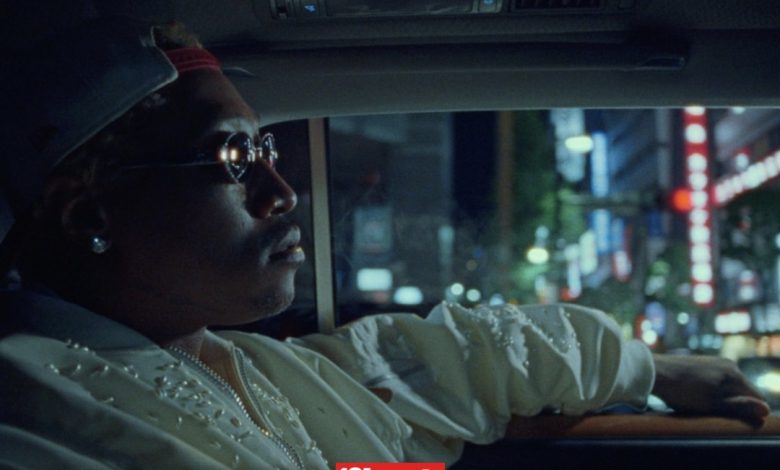
Future premiered the official “No Misery” music video on August 6, shot in Tokyo and directed by Loris Russier—and it’s the latest power move in what’s become a historically dominant year for the Atlanta legend.
The visual drops Future through Tokyo’s bustling streets, haunted by memories of a past romance, traveling across luxury cars and shadowy alleyways while sporting signature icy chains and an Atlanta Braves cap. Meanwhile, his former lover enjoys a vibrant night out elsewhere in the city, leaving him merely a fading memory by night’s end. Fans have praised the visual’s stylish direction and cinematic feel, with many calling it one of the strongest videos from the album.
But the video itself isn’t the story—what it represents is. “No Misery” comes from Future’s 12th studio album, “The Real Me,” which stormed to No. 1 on the Billboard 200 with 131K units, cementing his 12th career chart-topper and reasserting his place as one of the most dominant forces in modern music. Let that number sit for a second: 12. That’s not a typo. That’s a man who has redefined what it means to stay relevant in hip-hop.
With 12 No. 1 albums, Future now stands alone as the rapper with the third-most No. 1 albums in Billboard 200 history, moving ahead of Eminem, who has 11. Only Jay-Z (14), Drake (15), Taylor Swift (15), and The Beatles (19) have more chart-topping albums. That’s the kind of air Future’s breathing right now—in a conversation with The Beatles, not just rappers. This is generational dominance.
What makes this run even more ridiculous is the consistency. “No Misery” follows the release of tracks such as “Konnichiwa,” “Fukk a Interview,” and “California Girls” from “The Real Me”. Upon the album’s release on July 10, Future impressively charted with 17 entries across the all-genre list. That’s not just album strength—that’s ARTIST strength. Every track connects.
“The Real Me” marks a significant moment in Future’s catalog, his tenth solo studio album and a deeply personal body of work that strips back the mythology to reveal the man behind it, finding Future turning inward and delivering some of his most candid and ambitious music to date. That’s the secret sauce most rappers miss: growth without losing identity. Future can rap over Wheezy production and make people feel something real instead of just flexing empty bars.
The Tokyo setting for the “No Misery” video also deserves a mention. It’s not random. Future’s been on a global expansion wave—and the Japanese market, in particular, has been integral to hip-hop’s international growth over the past decade. Shooting there sends a message: this album is bigger than the States. This is world culture.
Of course, the video drop comes amid some noise in the culture. Beyond the album’s success, Future has beef to address—NBA YoungBoy dissed him, apologized, and later walked that back with a diss track, though YoungBoy said there isn’t any real beef, just behind-the-scenes tension. But that’s the game. When you’re sitting at 12 No. 1 albums and your latest project has 17 charting entries, diss tracks become background noise.
The broader context matters here. In the lead-up to release, Future descended on his hometown of Atlanta and staged a full-scale takeover—streets, skyline, and landmarks drenched in his signature purple haze and the unmistakable Freebandz logo, like a superhero marking his territory, with the show-stopping centerpiece being a 12-mile purple laser beam blasting from the top of the iconic Magic City straight into the Atlanta skyline. That’s the level of production and vision Future brings to his rollouts—not just music, but cultural moments.
For a generation that grew up on Future’s melodic trap sound, this moment is validation. For the culture, it’s a reminder that longevity isn’t about one-hit wonder fame or trend-chasing—it’s about evolving while staying true to your essence. Future didn’t chase drill, didn’t try to go trap-metal, didn’t collab with every TikTok novelty act. He stayed Future and the numbers prove it.
The 16BARS take: Future’s “No Misery” video is a flex wrapped in a heartbreak anthem, but the real power move is what it represents—album 12, still hitting number one with hungry videos, proving he’s not coasting on legacy. That 12 places him in company with Jay-Z and Drizzy, not just 2010s rappers. He’s not just making noise anymore; he’s writing the history book.