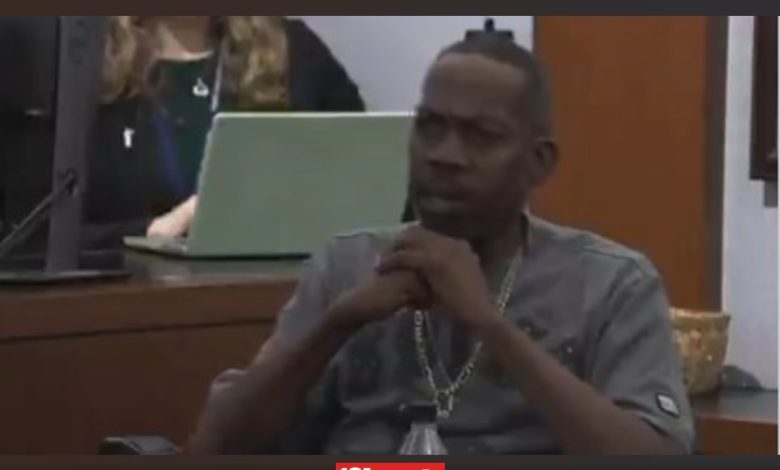
An old South Side Crips gang member testified today that his gang was aligned with Sean “Puffy” Combs’ Bad Boy Entertainment when it was warring with a Bloods sect associated with Death Row Records.
Devonta “Dirt Rock” Lee was involved in the assault with the Mob Piru gang in… pic.twitter.com/zPEO25eczm
— Meghann Cuniff (@meghanncuniff) August 21, 2026
Duane "Keefe D" Davis told police in 2008 about his involvement in Tupac Shakur's shooting and said Sean "Puffy" Combs offered to pay for the murders of Shakur and Death Row Records founder Marion "Suge" Knight, according to testimony from a retired Los Angeles police detective.… pic.twitter.com/lykvig6ICR
— Meghann Cuniff (@meghanncuniff) August 20, 2026
The Tupac murder trial just became a hip-hop history lesson, and the chain of custody is CRAZY. On Thursday, August 20, Devonta “Dirt Rock” Lee took the stand in Las Vegas—a former South Side Crips gang member testifying about the exact gang politics that, prosecutors argue, led to Tupac’s murder in September 1996. And his testimony went straight to the source: the Bad Boy and Death Row beef that defined the entire East Coast-West Coast era.
Lee testified that his gang, the South Side Crips, had a specific business arrangement protecting Bad Boy Records while the label warred with Suge Knight’s Death Row. When prosecutors asked if the Crips’ role with Puffy’s empire was to “ensure that Bad Boy was not bothered by other gangs,” Lee confirmed it straight up: “That was the basis of it… Yeah, they was worried about Death Row.” This wasn’t random gang drama—it was documented, organized protection for a record label in the middle of hip-hop’s bloodiest chapter.
But the testimony went deeper into the chain of events. Lee was involved in the Lakewood Mall incident weeks before Tupac’s death—when South Side Crips members allegedly snatched a Death Row chain off Mob Piru member Trevon Lane. That stolen piece of jewelry sparked a domino effect. Weeks later, on September 7, 1996, inside the MGM Grand after the Mike Tyson-Bruce Seldon fight, Tupac saw Orlando Anderson (Lee’s homie, also a South Side Crip) and beat him down in the lobby. Suge Knight joined in. Three hours later, Tupac caught four bullets in a white Cadillac at a traffic light. Dead six days after.
The crazy part? Lee admitted in grand jury testimony that he wasn’t at the shooting that night. But prosecutors are using him to map the infrastructure—who was with who, why the heat was on, how gang alliances tied directly to record label wars. If Death Row had Mob Piru muscle and Bad Boy had South Side Crips protection, then Tupac’s assassination wasn’t just retaliation for the MGM altercation—it was a hit tied to label territory and gang hierarchy.
Meanwhile, other testimony from retired detective Daryn Dupree keeps bringing Puffy back into the story. Dupree testified Wednesday that in 2008 interviews, Duane “Keefe D” Davis (the Crips leader now on trial for orchestrating the murder) claimed Sean Combs offered him money for the hit. Davis allegedly said Combs was supposed to give cash through Eric “Zip” Martin, but the money never reached him. That 2008 tip led feds to take Davis to New York undercover to reconnect with Martin at a club—a move that failed when Martin was too sick to meet.
What makes this explosive is the timing. Combs was running the East Coast’s biggest hip-hop operation while this coast-to-coast gang war was grinding. Death Row had Bloods muscle. Bad Boy apparently had Crips protection. And somewhere in that triangle, Tupac died. For thirty years, people have whispered about Diddy’s involvement. The courtroom is now dissecting whether money actually changed hands, whether it was always just talk, or whether Davis was gaming the system to get out of drug charges when he made those 2008 claims.
The defense is circling hard around witness credibility. They’ve hammered Lee for being a paid informant for years, pointed out his inconsistencies, and are arguing that none of this connects Davis physically to the shooting. Lee wasn’t there that night. The LAPD task force couldn’t pin down who pulled the trigger. All prosecutors have is a web of gang alliances, territorial beef, and testimony from people with criminal histories—people who, the defense says, will say anything to stay out of prison.
But what’s clear is this: the mid-90s hip-hop wars weren’t just about music beef or personality clashes. They were gang-organized, gang-protected, tied to street hierarchies that valued chains, reputation, and retaliation more than Billboard charts. Every label had muscle. Every neighborhood had a gang. And when Tupac threw a punch at Orlando Anderson, he wasn’t just starting a fight—he was violating a system that had existed long before Bad Boy and Death Row ever signed their first artist.
The 16BARS take: Dirt Rock’s testimony isn’t proof that Puffy pulled the trigger—but it IS proof that hip-hop’s biggest era was built on gangland economics. The chains mattered. The chains got people killed.