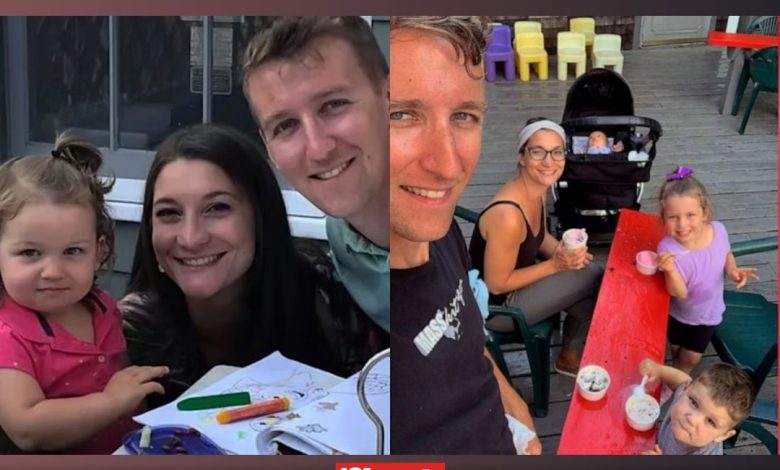
Patrick Clancy, the former husband of Lindsay Clancy, broke his silence Friday after a Massachusetts court declared a mistrial in one of the most divisive criminal cases of the decade—a high-profile case centered on postpartum psychosis, mental health accountability, and whether a mother facing criminal responsibility for killing her three young children could be held liable.
On September 4, 2026, after jurors deliberated for seven days and remained hopelessly deadlocked on a 11-to-1 split, Judge William Sullivan declared a mistrial in Plymouth Superior Court. The jury had been tasked with determining whether Lindsay Clancy, 36, was criminally responsible for the deaths of her three children—Cora, 5, Dawson, 3, and Callan, 8 months—or whether she was “not guilty by reason of lack of criminal responsibility” due to severe postpartum psychosis. The mistrial came after a last-minute emergency appeal by Clancy’s attorney, Kevin Reddington, to remove a holdout juror, an effort that Massachusetts’s top court denied within an hour.
Patrick Clancy, now remarried and living in New York, responded to the mistrial through his attorney David Meier with a carefully worded statement emphasizing his exhaustion. “Patrick Clancy is grateful to the Court and to the jurors for their hard work, their commitment, and their perseverance,” Meier said. But the real message came in the next breath: “The loss of Patrick’s children is something from which he will never recover and from which there will never be closure. The prospect of reliving this tragedy through another trial is extraordinarily painful—for Patrick, for his family, and for all of us.”
That statement—what it says and what it deliberately avoids saying—matters. Patrick Clancy was the first witness the prosecution called at trial, and he was also the person who discovered the bodies of his three children in the basement on January 24, 2023, after his ex-wife strangled them with exercise bands while he was out running errands for roughly 25 minutes. He’s also spent three years publicly supporting Lindsay’s mental health defense. In October 2024, he told The New Yorker: “I wasn’t married to a monster—I was married to someone who got sick.” He started a GoFundMe raising over $1 million in the days after the killings, writing that “the real Lindsay was generously loving and caring.”
But by Friday, Patrick Clancy was signaling something different: an exhaustion so profound it bordered on a plea not to retry the case. That signal mattered because prosecutors hadn’t yet committed to seeking a second trial. Plymouth County District Attorney Timothy Cruz said Friday that his office would make that decision at a later date.
The mistrial came after one juror refused to break rank with 11 others leaning toward conviction on first-degree murder charges. The defense argued that juror was philosophically aligned with their case—that postpartum psychosis is a legitimate mental illness that can deprive a person of criminal responsibility. The prosecution’s position: Clancy acted deliberately and remained responsible regardless of her mental state. That fundamental divide reflects a larger national conversation about postpartum mental health (postpartum psychosis affects approximately 1 to 2 in 1,000 women), motherhood, and the criminal justice system’s role in cases where severe psychiatric breakdown and infanticide collide.
Patrick Clancy’s statement Friday—carefully constructed to avoid any appearance of pressure on prosecutors—nonetheless read as a husband who has spent three years trying to defend his ex-wife’s illness to the public, surviving online conspiracy theories that wrongly blamed him for the murders, and now facing the possibility of doing it all over again in a second trial. The statement didn’t celebrate the mistrial. It acknowledged the jury’s work, honored his children’s memory, and made it clear: another courtroom battle would be devastating.
The 16BARS take: This case sits at the intersection of criminal responsibility, mental health reckoning, and family trauma—but Patrick Clancy’s exhausted reaction Friday signals that even victory in the court of public opinion doesn’t heal what’s broken. The next move is prosecutors’ call, but his plea for no retrial just became the subtext of this case.