
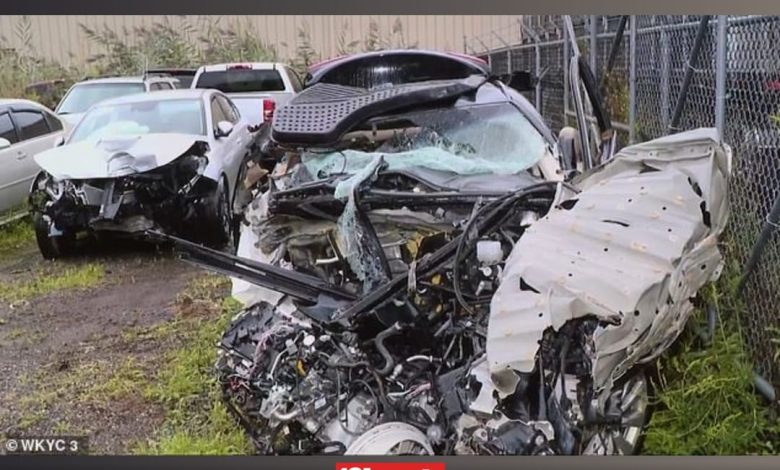
Mackenzie Shirilla is leaving the Ohio courts behind and taking her fight to the feds.
The 21-year-old, who was dubbed “hell on wheels” after intentionally driving her Toyota Camry into a brick building at 100 mph in July 2022, filed a federal petition for a writ of habeas corpus this week. She’s asking the U.S. District Court for the Northern District of Ohio to overturn her murder conviction and order a new trial. After years of getting shut down by state courts—including Ohio’s highest court—Shirilla is betting federal constitutional violations can get her another shot at freedom.
Shirilla was convicted in 2023 of murdering her boyfriend, Dominic Russo, 20, and their friend, Davion Flanagan, 19, in the deadly Strongsville crash. She was tried as an adult despite being just 17 at the time. A judge sentenced her to 15 years to life on concurrent sentences, meaning she won’t be eligible for parole until 2037. The conviction seemed airtight—prosecutors painted a narrative of a toxic relationship and an intentional act to end it. But Shirilla’s current attorney, Steven Bradley, is now arguing her original trial team botched the job so badly it violated her constitutional rights.
The specific claims are sharp. Bradley’s federal petition says Shirilla’s first defense team failed to present critical evidence: text messages showing Russo had grabbed the steering wheel during a separate driving incident weeks before the crash. That detail matters because it could support an accidental collision narrative instead of the prosecution’s “mission was death” theory. Even more crucial, the filing argues her trial attorneys never disclosed that Shirilla has postural orthostatic tachycardia syndrome (POTS), a documented medical condition that can cause sudden loss of consciousness and dizziness. If she had blacked out behind the wheel, that changes everything. The defense also claims prosecutors called a medical examiner to testify about autopsies the examiner didn’t personally perform—another procedural hole.
But the real wildcard in Shirilla’s favor might be a technicality that’s already bitten her twice. Her appeal was previously rejected on a leap year deadline issue—her attorneys allegedly miscalculated a 365-day filing window because of the February 29 math. The Ohio Supreme Court refused her request for reconsideration in June 2026, and an appellate court upheld that rejection in March 2026. Now she’s arguing in federal court that missing that deadline by a single day, due to a calculation error, was itself ineffective assistance of counsel. It’s the kind of procedural argument federal courts sometimes take more seriously than state courts do.
The case exploded back into public consciousness after Netflix dropped “The Crash” documentary in May 2026, which reopened questions about Shirilla’s memory loss, her POTS diagnosis, and whether the conviction was as airtight as the original trial portrayed. Prison disciplinary records have since emerged showing Shirilla behind bars—including contraband, medication violations, and 100+ unapproved video visits—which paints a picture of someone not exactly model-inmate material. But legally, none of that changes whether she got a fair trial.
Habeas corpus petitions are tough. They rarely succeed for non-death-penalty convictions, and federal courts typically defer to state court judgments. Shirilla faces long odds. But she’s also got something new on her side: federal jurisdiction, fresh eyes on the evidence her original team allegedly ignored, and a technicality that could matter in a courtroom not bound by Ohio state law. Whether that’s enough to crack open a conviction that two levels of state courts have already upheld is the real question.
The 16BARS take: Shirilla’s federal play is a last-resort chess move, but it’s got more ammunition than her state appeals did—neglected medical evidence, missing trial testimony, and a deadline miscalculation. Don’t count her out yet, but don’t expect the feds to throw open the cell doors either.